Original drawings by E.H. Shepard, illustrator of A.A. Milne’s Winnie-the-Pooh, are set to go on display in celebration of the book’s centenary. A hundred years after its first publication in 1926, never-before-seen sketches from E.H. Shepard will show how he brought the much-loved bear and his friends to life.
Two preliminary pencil sketches by E. H. Shepard have been shared for the first time by his family to mark the centenary of one of the most popular books in children’s literature. The first is a pencil drawing, captioned: ‘Climbing very cautiously up the stream’, which shows Pooh, Christopher Robin, Piglet and Owl navigating part of their “expotition” to the North Pole, lead by Christopher Robin. The illustration was intended for Chapter VIII of Milne’s book. Fans of the books will be familiar with the story but the accompanying illustrations were abandoned in the early stages of the book’s creation, and the depicted passages were ultimately not accompanied by drawings.
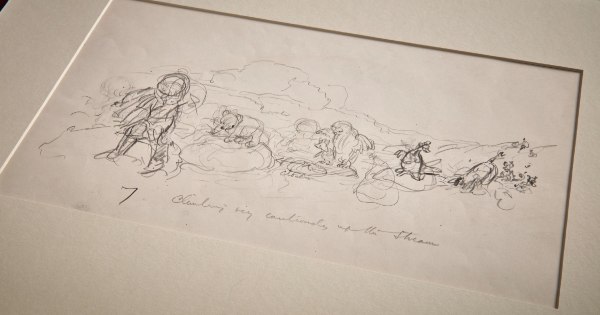
Photograph: Credit Peter Harrington
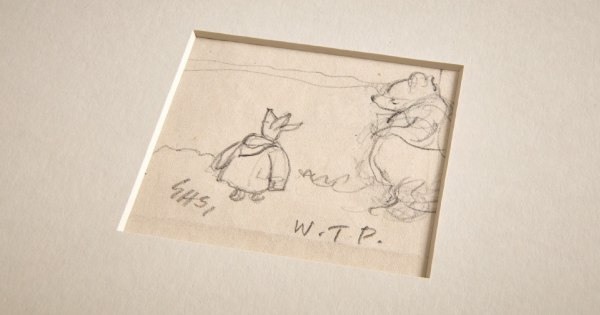
Photograph: Credit Peter Harrington
The second is a sketch that depicts Pooh and Piglet, and was intended for Chapter III, in which Pooh and Piglet Go Hunting and Nearly Catch a Woozle.
The drawings will be shown at Peter Harrington Rare Books in Dover Street, central London, as part of an exhibition that opens on 17th April.
Philip W Errington, a senior specialist at Peter Harrington, described the drawings as “very special”.
He explained: “[In] these preliminary sketches, Shepard’s putting these first thoughts on paper and there’s an absolute, vibrant creativity going on there.
“The skill that he’s got in rendering movement is really quite exceptional. The pencil marks across that page are really beautifully done. You’ve got the rapid creativity plus Shepard’s hallmark movement. These pieces really do leap off the page.
“It is extraordinarily rare to encounter preliminary drawings of Winnie-the-Pooh that capture what might be called the first moment of inspiration – the instant where Shepard is thinking through movement, character and narrative in pencil alone.”