Much-loved children’s author, Julia Donaldson, known for titles including: The Gruffalo, The Stick Man, Room on the Broom and many more classic titles, has successfully become the UK’s top all-time author by volume. In doing so, she has passed the previous all-time top author in the UK, J.K. Rowling.
In 2025, it was revealed that Donaldson had toppled the Harry Potter author from the top spot to become the UK’s bestselling author since accurate records began with BookScan’s launch in 1998. While Donaldson is currently the UK’s top-selling author, the statistics only go as far back as Nielsen BookScan’s Total Consumer Market (TCM) records began. The best-selling author in the UK, including data from before the records began, are estimated to be either William Shakespeare or Agatha Christie.
That does not negate the great feat of the former children’s laureate, Julia Donaldson, who sold more than 3.1 million copies of her books in 2024, according to Nielsen BookData, putting her sales two million more in volume than Rowling’s.
Over the past decade, Donaldson routinely outsold Rowling, in terms of volume, by 1.5 million to two million units via BookScan, slowly gaining on Rowling’s previously insurmountable volume lead.
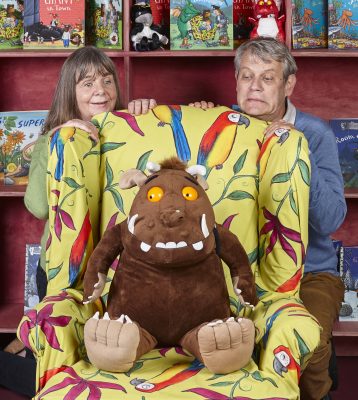
Julia Donaldson collaborates with illustrator, Axel Scheffler, to co-create titles including The Gruffalo.
While Rowling remains the bestselling author in terms on monetary volume, in terms of books sold, Donaldson’s lifetime book sales exceeded Rowling’s by 600,000, according to Nielsen BookData. Data revealed that Rowling’s sales to the consumer market of 48 million books during her lifetime as a writer were surpassed by Donaldson’s 48.6 million copies sold.
Despite being year-old data, Donaldson’s historic triumph has resurfaced in 2026 across social media, with many calling it a victory in the face of J.K. Rowling’s harmful anti-trans rhetoric that has caused many readers to turn their backs on the Harry Potter franchise.
2024’s data is also backed-up by more recent insights revealed by Neilson IQ exploring bestsellers and trends in 2025. Bestselling authors based on cumulative volume sales, included Julia Donaldson as the number one name in the UK, on both sides of the Irish Sea.