A newly transcribed story, written by mathematician Alan Turing, offers a new insight into his “playful, funny and cheeky” side, says Cambridge academic, Professor Sarah Dillon. Turing is best known for his pivotal role at Bletchley Park, breaking the enigma code which, many believe shortened the war by up to four years. Written a year after his arrest for gross indecency, at a time when Homosexual acts were still a criminal offence in the UK, Professor Dillon believes Turing’s short story will help challenge the thought that he was an “isolated mathematician”.
The Cambridge University English literature professor, Sarah Dillon has transcribed and studied the little-known short story that Turing wrote in the year after his arrest in Manchester, alongside Arnold Murray. She believes that a better way to remember and honour the icon of modern computing was as “playful, funny, cheeky, literary, and someone who really liked sex”.
“I hope it will go some way towards resetting the narrative around Turing,” she said. “We think we know this figure and we don’t. There was more to him than is popularly believed.”
The short story, which has been archived in King’s College, Cambridge, archives, was already known about by Turing experts but it had never fully transcribed or studied by a literary scholar, due to the hard to read handwriting which Dillon suggests is why the writing was long “side-lined and over-looked”.
Titled Pryce’s Buoy, the six-page incomplete story is believed to have been written in late 1952 or early 1953. Its central characters are Ron Miller, a working-class sex worker, and Alec Pryce, a scientist famed for an invention in his early twenties; the ‘Pryce’s buoy’. Dillon said the character of Alec was clearly auto-fictional; representing Turing himself.
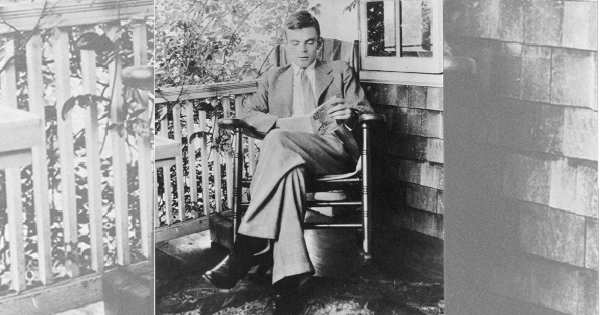
Alan Turing reading on the porch of a house (Archives Centre, King’s College, Cambridge, AMT/K/7/36)
The story itself is described as racy, switching from one narrator to the other as Alec, tired from work is seeking some fun. Meanwhile Ron is broke and unemployed, and turns to sex as a way to make money.
“Ron caught Alec’s eye and gave him a half-hearted smile. It was enough though.” write Turing.
Discussing the writing itself, professor Dillon says: ““I love the hesitancy, the way it evokes the uncertainty of potential sexual encounter, the ‘am I reading this situation wrong?’ worry. ‘Am I going to put my foot in it? Am I going to go too far? What did they want? What do I want? Can I back out?’
“Turing gets those tensions, the leaning in and backing out. He does it really well.”
Dillon’s findings, including a new complete transcription, are published in the Review of English Studies and she hopes it will provide a fresh insight into the great mathematical mind and LGBTQ+ icon from history.
“He’s come to be seen as socially unaware, entirely concerned with logic and numbers, and pretty isolated. His short story reveals a very different man: playful, funny, cheeky, literary, and someone who really liked sex.”