An academic at the University of East Anglia has identified the anonymous 16th-century author of a translation of Tacitus as Queen Elizabeth I.
Held in Lambeth Palace’s library ever since the 17th century, the work was identified by John-Mark Philo, an honorary fellow in English studies at the University of East Anglia.
While he was researching manuscript translations of arguably one of the greatest Roman historians, Publius Cornelius Tacitus, the academic scholar noticed that watermarks on the paper stock used for the translation – a rampant lion and the initials GB, with a crossbow countermark – were ones used for Queen Elizabeth I’s personal translations and private correspondence.
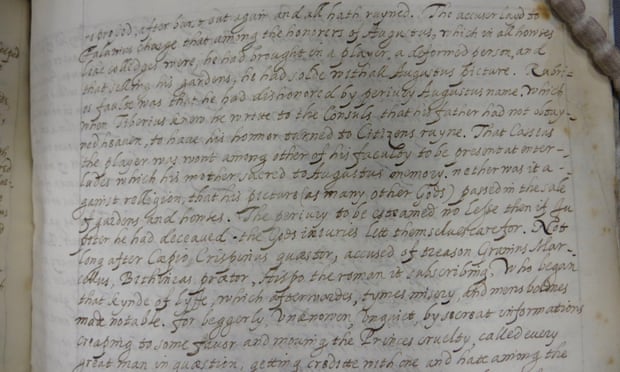
Queen Elizabeth I was the only translator known at court in the late 16th century to have translated any of Tacitus’s Annals. Her contemporary John Clapham described taking “pleasure in reading of the best and wisest histories, and some part of Tacitus’s Annals she herself turned into English for her private exercise” and identified her handwriting as “an extremely distinctive, disjointed hand”.
According to The Guardian, Philo had noted:
“The paper stock first got me thinking – it’s a very specific kind of paper, but I was still being rigorously pessimistic. The thing that clinched it for me was the handwriting. That was the strongest clue. I collected as wide a sample of her handwriting as possible and compared her other translations.”
“Her late handwriting is usefully messy – there really is nothing like it – and the idiosyncratic flourishes serve as diagnostic tools. If you were a professional scribe you were trained to write regularly and elegantly, you needed your writing to be understood. As a general rule the higher up the hierarchy you are the more liberties you can take. In her later years, you have letters sent by Elizabeth and then an aide adding: ‘Sorry, please find a fair copy here.’ In terms of proving someone’s authorship that’s an absolute gift. That was the exciting moment, the real clincher.”
Philo’s article on his discovery was published in the Review of English Studies on Friday 6th December 2019.
Netflix launch new partnership with the British Library

We’re Going on a Bear Hunt to return nearly four decades later
First Edition found in charity shop acquired by British Library