By Nicky Blewitt
When I first picked up The Ragged Trousered Philanthropists in 1985, I’ll admit—I was braced for a slog. It’s got one of those titles that sounds like a Victorian moral lecture, the sort of thing you expect to be stuffed with dusty sermons about thrift and virtue. But within a few pages, there it was: a bunch of painters and decorators on a building site, skint, tired, making grim jokes while trying to stretch their wages just far enough to put bread on the table. It felt familiar. Uncomfortably familiar, actually.
Robert Tressell, who wrote it back in the early 1900s in my hometown of Hastings on the south coast of England. He wasn’t writing about far-off aristocrats or candlelit parlours. He was writing about working men in a small town, their families, their constant battle to make ends meet. It’s a book full of cold houses, pawnshops, and the sheer exhaustion of scraping by. Swap out horse-drawn carts for Deliveroo bikes and it wouldn’t feel so out of place today.
Here’s the thing about The Ragged Trousered Philanthropists: it’s not just a story; it’s a sort of howl. Tressell saw ordinary workers giving away their lives—their health, their time, their dignity—in exchange for scraps, while the people at the top made fortunes off their backs. And instead of rising up, most of them accepted it. They were, in Tressell’s biting phrase, “philanthropists,” gifting their labour to the wealthy, day after weary day.
You might be wondering, alright, but isn’t that just history? Haven’t we moved on a bit? Minimum wage, health and safety regulations, weekends that aren’t swallowed whole by work—surely that’s progress. And yes, fair point. But read the book with modern eyes and you can’t help noticing the echoes. Gig economy jobs where people are “self-employed” but still can’t refuse shifts. Rising rents eating up pay packets. Politicians telling us to tighten belts while CEOs pocket bonuses. Sound familiar?
There’s a famous scene in the novel known as “The Great Money Trick.” One of the painters, Owen, lays out a simple demonstration using slices of bread to show how workers create all the wealth but end up with almost none of it. It’s so straightforward that you wonder why on earth it isn’t taught in every school. Honestly, when I first read it, I had to put the book down and think. It was like someone had drawn back a curtain. Suddenly you could see the mechanics of inequality—not abstract statistics, but the lived reality of who gets what, and why.
And maybe that’s why the book keeps cropping up, decade after decade. In times of economic squeeze, it comes back into circulation like an old song that still hits a nerve. During the 1970s strikes, it was waved around on picket lines. In the 2008 crash, people dusted it off again. And now, in an era of food banks and zero-hours contracts, it feels as raw and pointed as it did a century ago.
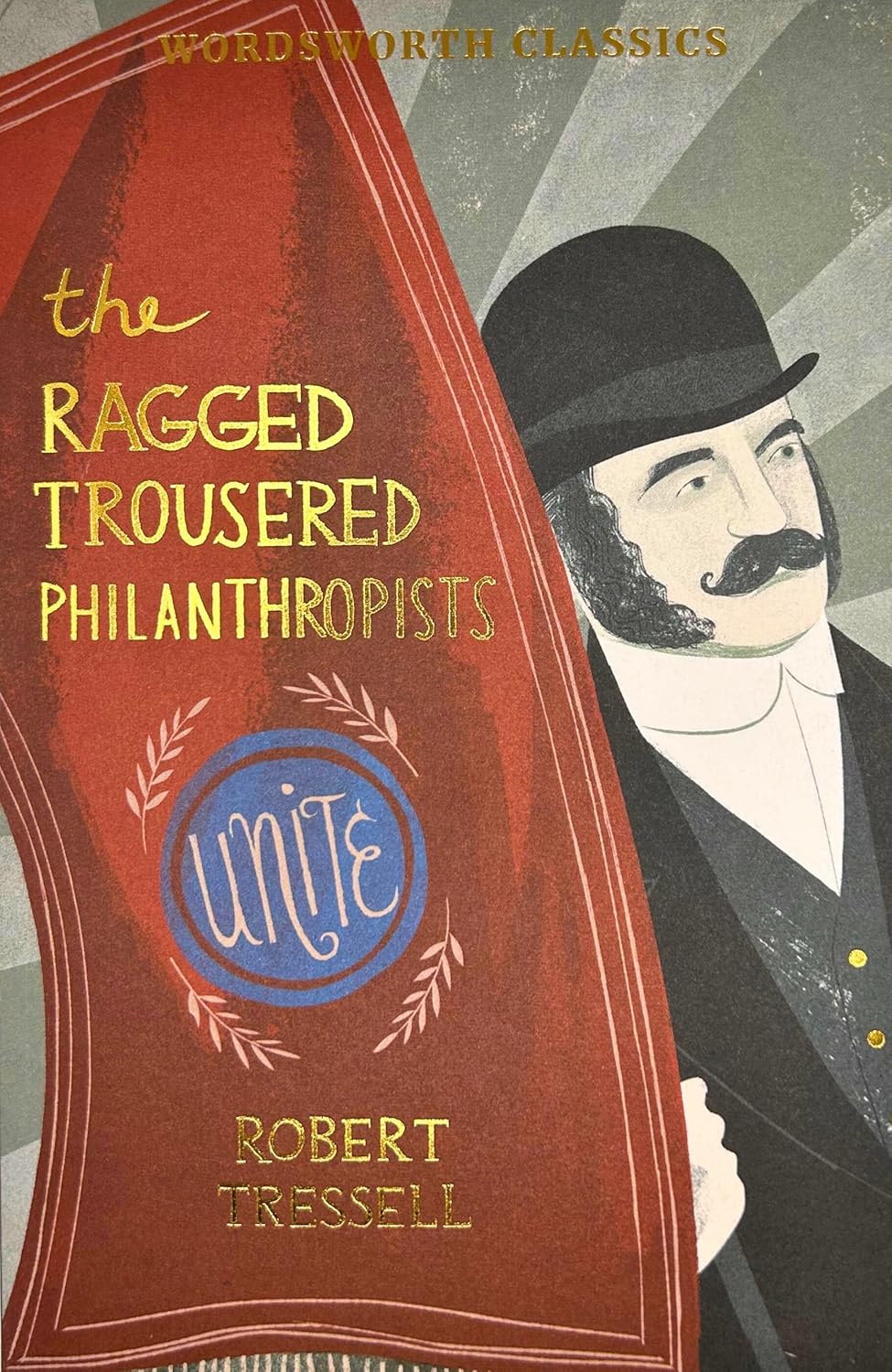
Here’s a small confession: I once tried reading it during my lunch breaks when I was temping in an office. The irony wasn’t lost on me—me in my scratchy suit, microwaving leftovers, sneaking in a chapter while the clock ticked down. I couldn’t help but notice how much of what Tressell described was still playing out in the office politics around me. The manager’s pep talks about “team spirit” sounded a lot like the foreman in the novel telling men to work harder for the good of the company. Different era, same script.
It’s not a perfect book. Sometimes Tressell gets preachy. There are long passages where Owen, the socialist voice, explains economics at such length you almost want to beg him to stop. But even those bits feel oddly endearing, like listening to a mate in the pub who’s desperate to convince you of something that really matters. When you see what Tressell was up against—publishers refusing to touch a novel by a working-class house painter—it’s kind of a miracle the book survived at all. He died before it was even published, and the first edition was heavily cut down.
What makes the novel really sting is the way it captures resignation. The workers moan about their lot, sure, but most of them can’t imagine anything different. When Owen talks about socialism, they laugh, or call him a dreamer, or mutter that it’ll never happen here. That sense of learned helplessness is probably the saddest thread running through the book. And again—doesn’t that sound familiar? How often do you hear people say, “That’s just how things are”?
You could argue the novel’s relevance today isn’t just in its economic critique, but in its reminder that stories can stir us in ways statistics can’t. A graph about wealth inequality might make you tut. But a scene of a child going hungry while her father paints yet another wealthy man’s house—that stays with you. Tressell forces us to feel inequality, not just observe it.
I sometimes wonder what Tressell would make of life in 2025. Would he be shocked at how far we’ve come, or gutted at how far we haven’t? Probably both. He’d see universal healthcare as a victory (though under constant siege). He’d see ordinary people still struggling to pay rent, food banks in every town, and politicians telling us it’s our fault if we can’t “budget properly.” He’d probably roll his eyes and say, “I told you so.”
The book’s not just a relic; it’s a challenge. It asks us, bluntly, why do we still tolerate systems that grind people down? Why do we keep giving away our time and energy so cheaply? And most awkward of all, what would it take for us to imagine something different?
If you’ve never read The Ragged Trousered Philanthropists, don’t be put off by the size or the old-fashioned style. It’s worth it. Not because it gives you neat answers (it doesn’t), but because it opens your eyes to questions that are still right there in front of us.
And if you do pick it up, maybe try reading it the way I eventually did: not in guilty snatches between emails, but slowly, with space to think. It’s a book that doesn’t just sit on the page; it sits with you, niggling, needling, refusing to let you shrug off the uncomfortable stuff.
Over a hundred years old, written by a painter who never saw his work reach print, and still—somehow—it speaks. Which is sort of depressing, but also strangely hopeful. Because if stories can last that long, maybe change can too.
Nicky is a science Fiction author and Book marketer that runs www.thebookmarketer.pro which is a support service that teaches authors the skills they need to get their books visible. They have a bursary scheme to support low- income authors.